By the late 1800s and early 1900s, easily accessible gold had largely been depleted. Mining companies turned to a new method: gold dredging, which dramatically reshaped areas like Sailor Bar.
The Companies Behind Sailor Bar’s Dredging and Gravel-Mining History
Today, Sailor Bar is known for its trails, wildlife, fishing, boating, birdwatching and beautiful stretches of the American River. But the landscape visitors see today was shaped in large measure by a very different era—when Sailor Bar was one of the important gold-dredging sites along the American River.
Beginning around the turn of the twentieth century, large floating dredges systematically excavated the gravel deposits at Sailor Bar in search of gold. The machines dug deep into the river terrace and floodplain, processed enormous quantities of gravel, and then deposited the unwanted rock behind them. The long, irregular piles of rounded cobbles and gravel that characterize portions of Sailor Bar today are the surviving dredge tailings from this era.
The Ashburton Mining Company
The most important company in Sailor Bar’s dredging history was the Ashburton Mining Company of Boston.
In the spring of 1899, Ashburton sent two test drills to Sailor Bar to determine whether the gravel deposits contained enough gold to justify large-scale dredging. The tests proved promising, and the company leased approximately 310 acres of auriferous gravel land at Sailor Bar and proceeded to construct a large bucket-line dredge. Contemporary accounts describe the property as being on the north side of the American River near Fair Oaks.
Construction of Ashburton’s first dredge began in 1899. The boat was launched in June 1900 and was christened Hercules. Its bucket line consisted of dozens of heavy buckets that continuously scooped gravel from the bottom of the dredge pond. The material was brought aboard, screened and processed to recover gold, while the waste rock was returned to the ground as tailings.
The scale of the operation was extraordinary for its time. A contemporary mining account reported that the Ashburton dredge was capable of handling approximately 3,000 cubic yards of material per day and represented an investment of roughly $100,000—a tremendous sum in the early 1900s.
Ashburton’s No. 1 dredge was eventually rebuilt and improved. According to a 1914 engineering account, the reconstructed dredge was equipped with a new bucket line, new spuds and a belt conveyor for stacking the tailings. The company subsequently built a second dredge, Ashburton No. 2.
The first dredge operated at Sailor Bar from March 1900 through December 1907. The Ashburton Mining Company then continued its dredging operations elsewhere in the American River district, completing its remaining territory near Folsom at the end of 1913.
A California historical study likewise identifies Sailor Bar as having been dredge-mined by the Ashburton Mining Company between approximately 1899 and 1913, and notes that the company’s first dredge was the second bucket-type dredge to operate in the Folsom Mining District. That dredge was destroyed by fire in 1903 and subsequently rebuilt.
A Remarkable Industrial Operation
The technology used at Sailor Bar was impressive.
A bucket-line dredge was essentially a floating mining factory. A continuous chain of large buckets descended from the front of the dredge into the gravel, scooped up material and carried it aboard. There, screens and sluices separated the gold-bearing material from the enormous quantities of rock and gravel.
An account published in 1905 provides an extraordinary description of Ashburton’s operation at Sailor Bar. The dredge initially deposited the larger boulders directly beneath the barge while finer material was carried through a long swinging sluice. This arrangement allowed the discarded material to be redistributed across the mined area.
Sailor_Bar_Gold_Dredge_Article
The operation was powered by electricity supplied from the Folsom area. Contemporary descriptions indicate that the dredge employed several electric motors, including a 500-horsepower motor to operate the bucket line.
In other words, what may look today like a collection of natural gravel hills and rocky terraces is, in many places, an industrial landscape created by machinery more than a century ago.
Other Companies in the American River Gold-Dredging District
Sailor Bar was part of a much larger gold-dredging industry that developed along the American River between Folsom and the Sacramento area.
The Colorado Pacific Gold Dredging Company, for example, began dredging in the American River district in 1899 at Mississippi Bar, downstream from Sailor Bar. Its dredges were among the early large-scale bucket dredges in the region.
Other companies active in the broader Folsom/American River district included the Folsom Development Company, El Dorado Gold Dredging Company, and Natomas Development Company. By the early 1900s, these operations had helped transform the American River corridor into one of California’s major gold-dredging districts.
The later Natomas Consolidated of California became particularly important in the American River mining industry. Historical records indicate that by 1909 the company controlled more than 5,600 acres of dredgeable land in Sacramento County and operated numerous dredges in the American River district. However, it is important not to confuse these larger regional operations with the specific dredging history of Sailor Bar: the strongest historical documentation identifies Ashburton Mining Company as the company that actually dredged Sailor Bar during its principal early dredging period.
From Gold Mining to Gravel
Gold was not the only legacy of these operations.
The dredges moved enormous quantities of river gravel in their search for gold. What remained was deposited as dredger tailings—the distinctive piles of rounded cobbles and gravel that still cover portions of Sailor Bar.
Sacramento County records describe Sailor Bar as the site of extensive gold-dredging operations from approximately 1900 to 1962, although the historical sources indicate that the major Ashburton dredging era occurred much earlier. The later period reflects the continuation of mining activity in the broader area. The dredging dramatically altered the original landscape, leaving behind largely unvegetated tailing piles and creating the unusual topography visible at Sailor Bar today.
Commercial sand and gravel production along the Lower American River
The history of Sailor Bar did not end with the gold dredges. Sand and gravel production continued on both the south shore and the north shore of the river. One of the largest aggregate operations in the Central Valley took place in the area that is now known as Gold River. The coarse dredge tailings that remained after the dredging ceased were washed, crushed and graded. This plant was leased to Coast Rock and Gravel Company in 1920 and became part of Pacific Coast Aggregates in 1929. In the 50’s and 60s huge rock crushers operated 24 hours a day and the sound of the crushers could be heard all over Fair Oaks. In addition, the Fair Oaks Gravel Company processed and sold sand, gravel, rock and ready mix concrete at Sailor Bar as well.
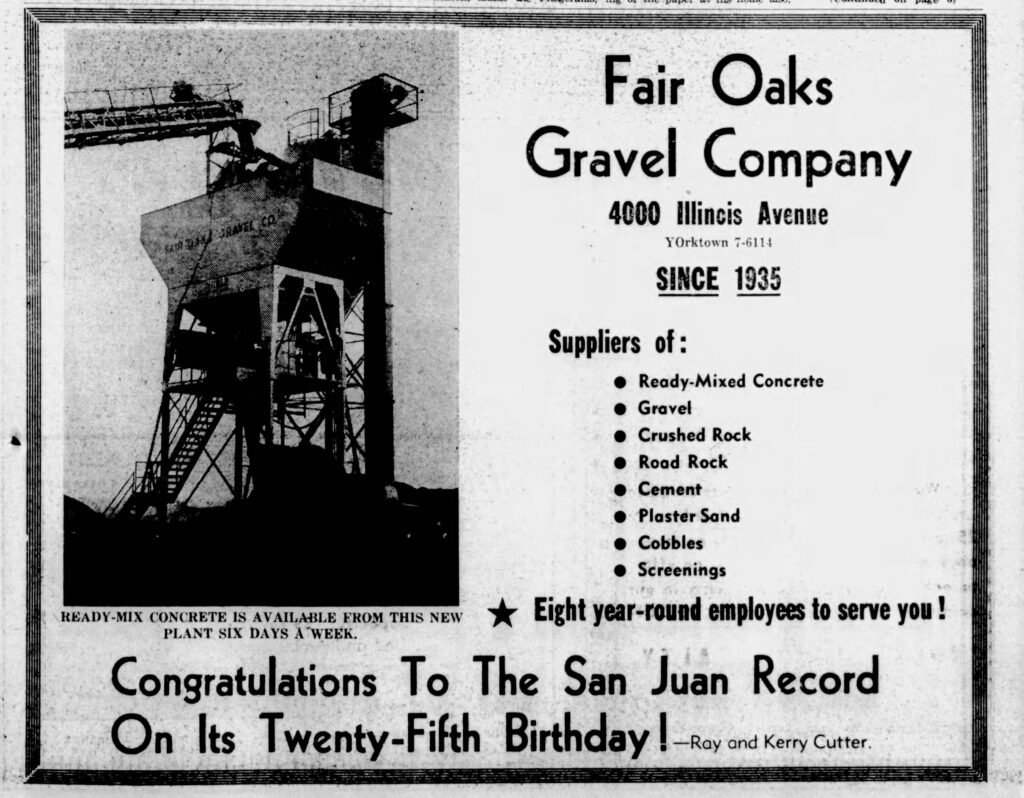
Over time, nature began to reclaim this industrial landscape. Trees and other vegetation took root in the sheltered ravines between the tailings. Today, those same areas provide valuable habitat for birds and other wildlife.
What Is a Gold Dredge?
A gold dredge was essentially a floating industrial mining machine — part boat, part factory. They operated in large ponds they created as they dug. Some dredges were the size of multi-story buildings and ran continuously, often 24 hours a day.
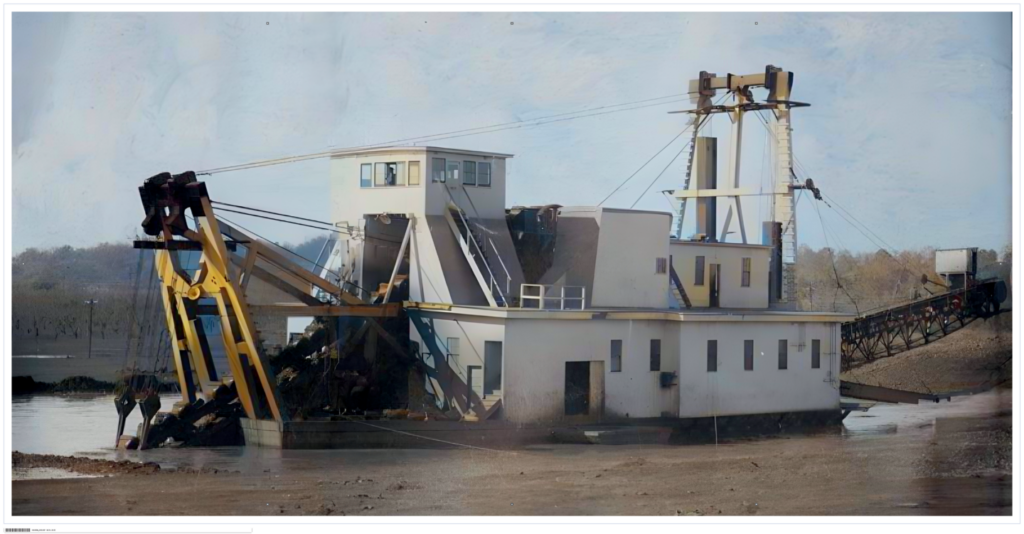
How Dredges Worked (Step-by-Step)
- Digging with the Bucket Line — A continuous chain of large steel buckets rotated at the front of the dredge, scooping up gravel, sand, and sediment from the riverbed, including ancient river deposits buried deep underground.
- Lifting Material — Buckets carried material up into the dredge and dumped it into processing equipment onboard.
- Processing for Gold — Material passed through screens and crushers. Water was used to wash and separate sediment. Gold, being heavier, settled into sluices or riffles.
- Discarding Tailings — Waste rock and gravel were dumped out the back, creating long rows of rock piles called tailings.
- Self-Advancing Operation — As the dredge dug forward, it floated in its own pond. The pond moved with the dredge as it advanced across the landscape.
Video: Gold Dredge (Internet Archive film, starts at 0:20)
What Makes Sailor Bar Unique
The rock piles (tailings) seen today at Sailor Bar are direct evidence of dredging. These piles often appear as long ridges or windrows and unnaturally uniform rock fields. The original landscape — soil, vegetation, and river channels — was completely reworked.
Scale and Impact
Dredges could process thousands of cubic yards of material per day. Entire sections of the American River floodplain were transformed. Natural habitats were destroyed and replaced with rocky, barren terrain.
Dredging required large crews and constant maintenance. Machinery wear and breakdowns were common. Operations depended on water availability and stable economic conditions.
Environmental Legacy
- Loss of native vegetation and soil structure
- Altered river channels and floodplain dynamics
- Long-term habitat disruption
Today, some areas have been naturally or intentionally restored, but the dredger impact is still clearly visible.