A Gold Rush Legacy Visible from Sailor Bar
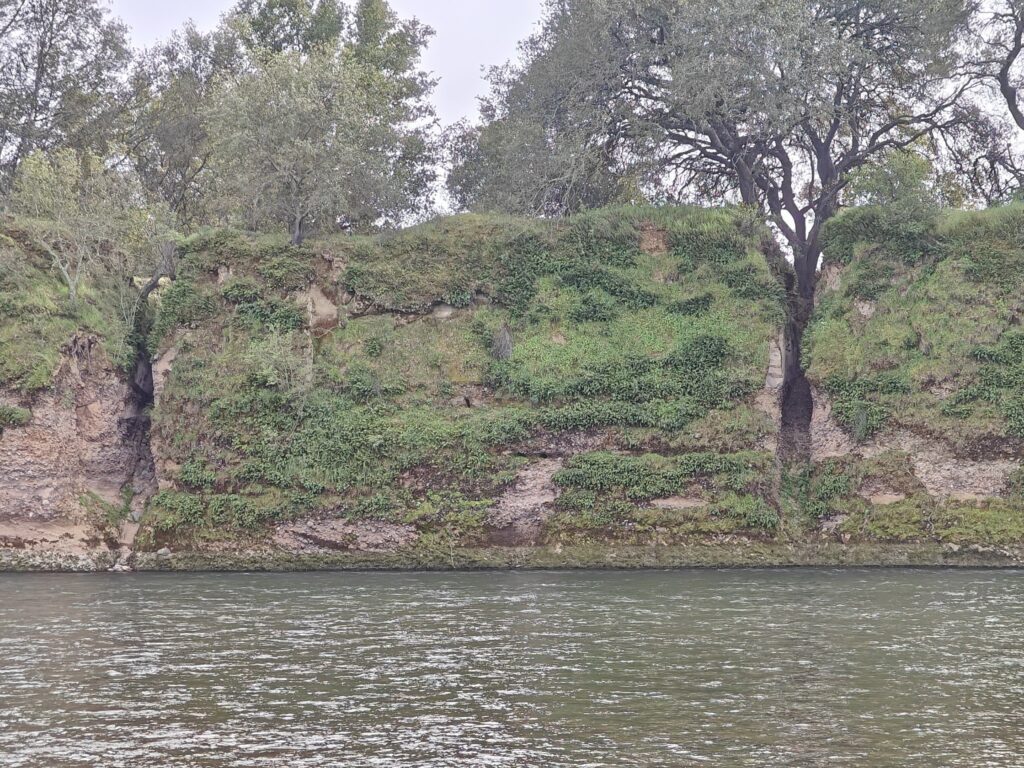
Look across the American River from Sailor Bar toward the steep bluff on the opposite bank. Among the trees and vegetation, you can see a series of narrow cuts and deep, vertical openings in the face of the bluff.
These unusual features are remnants of the historic mining landscape along the American River. They are commonly associated with the Chinese Diggings, where Chinese miners worked the river’s gold-bearing deposits during the Gold Rush era and the decades that followed.
What Are We Seeing?
The narrow cuts visible in the bluff are the most distinctive surviving evidence of the old workings. They penetrate the steep riverbank in places, exposing layers of gravel and earth.
Gold was deposited in the gravel beds of the American River over thousands of years. During the Gold Rush, miners learned to excavate these deposits and wash the gravel to recover the heavier gold.
As the richest and easiest deposits were worked out, miners returned to ground that had already been mined, searching for gold that remained in the gravel. Mining along the riverbanks could involve cutting into the bluffs and terraces, sometimes producing the narrow excavations that can still be seen today.
The precise history of each individual cut is difficult to establish from the surviving landscape. However, the features are part of a larger area of historic placer mining that was worked by Chinese miners and others during the Gold Rush period.
Chinese Miners on the American River
Chinese immigrants played an important role in the mining history of the American River.
Thousands of Chinese immigrants came to California during and after the Gold Rush, many from southern China. Chinese miners developed a reputation for patiently reworking older mining areas, recovering gold that remained after earlier operations had removed the richest deposits.
Historical records specifically document Chinese miners working at Sailor Bar and along the American River during the 1850s and 1860s. Their presence was part of a much larger Chinese mining community that developed throughout the Sacramento region.
Their work was often carried out under difficult circumstances. Chinese miners faced widespread discrimination and were frequently pushed onto less desirable claims. Despite these obstacles, they continued to make an important contribution to California’s mining economy.
Reading the Landscape
The Chinese Diggings are a reminder that the Gold Rush was not simply a story of prospectors arriving, finding gold, and moving on.
Mining continued for decades as successive generations of miners searched for gold left behind by earlier operations. The landscape was repeatedly excavated, washed and reshaped.
From Sailor Bar, we can see only a small portion of this historic landscape. Vegetation and erosion have obscured much of the evidence, while the river itself has continued to reshape the bank.
Yet the narrow cuts in the bluff remain visible across the river, providing an intriguing glimpse into the intensive mining that once took place here.
Look Across the River
The next time you visit Sailor Bar, look across the American River at the bluff.
The narrow openings in the bank are easy to overlook. They may appear at first to be simply unusual features of the eroded hillside. But they are part of a landscape shaped by generations of people searching for gold.
These remnants connect us to the Chinese miners and others who worked along the American River more than 150 years ago.
Please observe the historic landscape from a distance. Do not climb, dig into, or remove material from the old workings. What remains is a fragile part of the history of the American River.