Editorial note: This page describes a reported nesting site; it is not a claim that a nest is currently occupied. Never approach, climb toward, call to, shine lights on, or otherwise disturb nesting wildlife. Observe wildlife from a respectful distance and follow all posted closures and guidance.
A hidden nest with a remarkable view
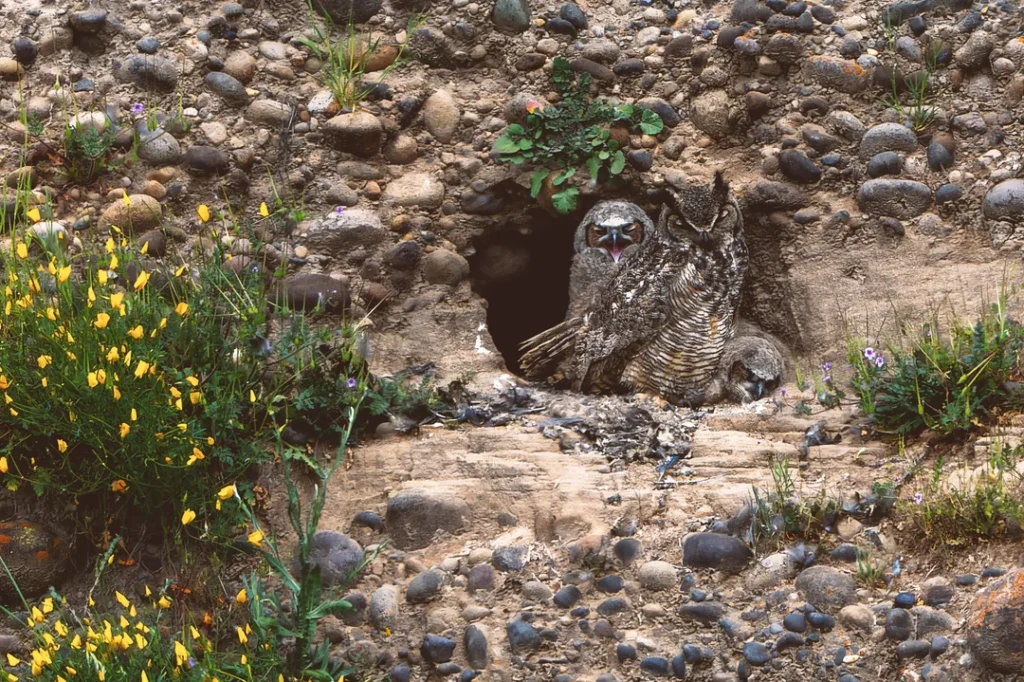
The steep bluffs above the river just to the east of the Sailor Bar Boat Launch are home to a remarkable sight—a nesting cavity used by a Great Horned Owl.
The nest is difficult to see from Sailor Bar itself. The best opportunity to observe it is from the opposite side of the river, near the Nimbus Fish Hatchery, where the bluff can be viewed from a different angle.
It is a fitting reminder that the American River Parkway is more than a place for people to hike, fish, and enjoy the river. The cliffs, trees, shrubs, and riparian forests along the river provide shelter and nesting habitat for an extraordinary variety of wildlife.
A very unusual nest site
Great Horned Owls are remarkably adaptable when it comes to choosing a nest. Unlike many birds, they do not normally construct their own nests. Instead, they often take over an abandoned nest built by another large bird, such as a hawk, crow, raven, heron, or eagle.
But they are not limited to tree nests. Great Horned Owls may also nest in natural cavities, caves, on cliff ledges, and in other sheltered locations.
The Sailor Bar owl appears to have taken advantage of exactly this kind of habitat—a protected cavity in the steep river bluff.
The Sacramento Audubon Society has documented Great Horned Owls using riverbank cavities in this area. In February 2026, an Audubon field trip at the Nimbus Fish Hatchery reported seeing a Great Horned Owl occupying a “riverbank cave nest.”
A predator perfectly suited to the river corridor
Great Horned Owls are among the largest and most powerful owls in North America. Their distinctive feather tufts give them their familiar “horned” appearance, although those tufts are not actually ears.
They are primarily nocturnal hunters. From a high perch, an owl can listen and watch for prey before silently swooping down to capture it. Their diet is remarkably varied and can include rats, mice, rabbits, squirrels, birds, reptiles, amphibians, and other animals.
The American River corridor provides an excellent combination of habitats for a hunting owl: dense riparian vegetation for cover and roosting, open areas where prey can be detected, and the river bluffs themselves for protected nesting and resting places.
Great Horned Owls are also remarkably adaptable. They can live in forests, river valleys, grasslands, agricultural areas, parks, and even urban environments.
Look—but give the owl some space
A nest like this is exciting to discover, but it is important to remember that the owl’s home is not a viewing attraction. During nesting season, disturbance can cause unnecessary stress to the adults and young.
Fortunately, this nest can be appreciated from across the river. Please do not attempt to approach the cavity, climb the bluff, or enter the area around the nest. Binoculars or a spotting scope provide a much better—and safer—way to observe the birds.
Audubon recommends keeping a good distance from nesting owls and avoiding playback of owl calls, particularly during breeding season. Shining lights at owls should also be avoided.
An unexpected neighbor at Sailor Bar
The Great Horned Owl is one of many species that share the American River corridor with the people who visit Sailor Bar.
From the park, visitors may notice hawks circling overhead, herons along the river, songbirds moving through the willows and cottonwoods, and occasionally the unmistakable silhouette of a large owl.
The owl nest across the river is a particularly special discovery because it is almost invisible from the park. It illustrates an important lesson about the American River Parkway:
Wildlife habitat doesn’t always announce itself. Sometimes you have to stop, look across the river, and know where to look.
Where can you see the nest?
The nesting cavity is located in the steep bluff along the American River just east of Sailor Bar. It is not readily visible from Sailor Bar. The best viewing opportunity is from the vicinity of the Nimbus Fish Hatchery, looking across the river toward the bluff.
If you are fortunate enough to spot the owl, enjoy the sight from a distance and allow this remarkable resident of the American River to remain undisturbed.
Did you know?
Great Horned Owls don’t usually build their own nests.
They commonly reuse abandoned nests built by other large birds, but they can also nest in cavities, caves, cliffs, and ledges. Their willingness to use such a wide variety of nest sites is one reason they are able to thrive in so many different environments.